

Board Performance · 2025
In this section15 topics
- Compliance Monitoring — Overview2 items
- Prevention of Conflicts of Interest3 items
- Prevention of the Use of Inside Information3 items
- Anti-Corruption4 items
- Whistleblowing4 items
- Selection of Directors & Chief Executives7 items
- Selection of Independent Directors2 items
- Director Development3 items
- Evaluation of Board & Subcommittee Performance3 items
- Subcommittees1 item
- Meeting Attendance & Remuneration7 items
- Supervision of Subsidiaries & Associated Companies4 items
- Board Duty Performance — Overview1 item
- Audit Committee Duty Performance1 item
- Executive Committee Duty Performance1 item
Compliance Monitoring — Overview
Compliance Monitoring — Introduction
The Company prioritizes good corporate governance by establishing relevant policies and guidelines within its corporate governance policy and business ethics, and promoting genuine implementation to build trust among all stakeholders.
The Company continuously monitors and evaluates compliance with good corporate governance principles. The monitoring results indicate that the company can fully implement the guidelines for each issue. In 2025, the Company's Directors and Executives did not commit any violations related to the use of inside information for personal gain.
Monitoring of Compliance with Other CG Policies & Guidelines
The Company prioritizes good corporate governance by establishing relevant policies and guidelines in its Corporate Governance Policy and Business Ethics, and promoting their genuine implementation to build confidence among all stakeholders.
Over the past year, the Company has monitored the implementation of good corporate governance covering topics such as:
1) Employee care and non-discrimination.
2) Stakeholder responsibility.
3) Environmental care, hygiene, and safety within the organization.
The monitoring results indicate that the Company has fully implemented the guidelines for each issue.
Prevention of Conflicts of Interest
Has the Company Acted to Prevent Conflicts of Interest?
Yes
Operations in the Past Year
The Company has established a policy requiring directors, executives, and employees to perform their duties for the company's best interests. In cases where any individual has an interest or is involved in a transaction under consideration, such individual must inform the relevant oversight unit and refrain from participating in the consideration of that transaction.
In 2025, the Company investigated cases that might lead to conflicts of interest and found no transactions involving the Company's Directors, Executives, and employees, aiming to enhance internal corporate governance.
The Company has measures to oversee the interests of its directors and executives, by requiring directors, executives, and related persons to report their interests that are related to the management of the Company's business, as follows:
Report upon first assuming the position of director or executive.
Report upon any change in interest information.
Directors and executives submit the interest disclosure form to the company secretary, who will then forward a copy of the interest report to the Chairman of the Board and the Chairman of the Audit Committee for their acknowledgment within 7 business days from the date of receiving the report.
In 2025, the Company's Directors and Executives complied with the established criteria.
Number of Conflict-of-Interest Cases
| Metric | Current Year | Previous Year | Two Years Ago |
|---|---|---|---|
| Total number of cases or issues related to conflicts of interest (cases) | 0 | 0 | 0 |
Prevention of the Use of Inside Information
Has the Company Acted to Prevent the Use of Inside Information?
Yes
Operations in the Past Year
The Company has measures to oversee the trading of its securities, as stipulated in the Business Ethics and the Code of Conduct for Directors, Executives, and Employees, which prohibits directors and executives from trading the Company's securities during the one-month period prior to the public disclosure of financial statements each quarter. The company secretary provides notifications to acknowledge the prohibited trading period for the Company's securities until 24 hours after the information has been publicly disclosed. Furthermore, the policy requires directors and senior executives to inform the Company Secretary about any trading of the Company's shares at least one day in advance of the transaction. Additionally, directors and executives (including their spouses and minor children) are required to report their securities holdings if there is any trading of the Company's securities. They must notify the Securities and Exchange Commission (SEC) and submit a copy to the Company Secretary for reporting to the Board of Directors at the next Board meeting. At every quarterly Board meeting, there will be an agenda item for reporting the Company's securities holdings by directors and executives. Should there be any announcement of changes regarding this matter, the Company Secretary will send a letter to inform the directors and executives, along with a copy of the letter and the announcement from the Securities and Exchange Commission concerning the matter.
In 2025, the Company's Directors and Executives have complied with the policy, and no trading was observed during the prohibited period.
Changes in the Company's securities holdings by the Company's directors and executives as of December 31, 2025.
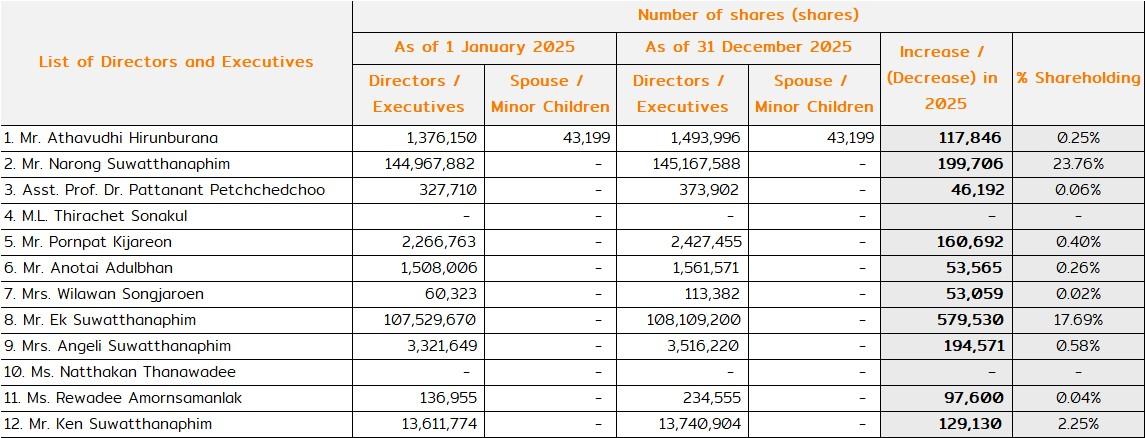
Number of Inside-Information Cases
| Metric | Current Year | Previous Year | Two Years Ago |
|---|---|---|---|
| Total number of cases or issues related to the use of inside information to seek benefits (cases) | 0 | 0 | 0 |
Anti-Corruption
Has the Company Acted on Anti-Corruption?
Yes
Operations in the Past Year
The Company remains committed to conducting business with integrity, transparency, accountability, and in accordance with good corporate governance principles and business ethics. It recognizes that integrity is crucial for ethical performance and has always been a guiding principle in the company's operations. Key practices include:
Anti-Corruption
The company participated in the declaration of intent to become a member of the Thai Private Sector Collective Action Against Corruption (CAC) and received its second re-certification on September 30, 2024, reaffirming its commitment to promoting transparency and combating corruption. Additionally, the company joined the "Call for Action...We Report" project to raise awareness among executives and employees about the importance of reporting corruption.
Gift Policy
The Company refrains from accepting gifts during the New Year and all other festive seasons from business partners and stakeholders to support transparent operations and avoid conflicts of interest.
Employee Communication and Training
The Company provides communication and training to employees on anti-corruption policies and practices and business ethics to raise awareness and ensure compliance by all employees, as well as to inform business stakeholders.
Practical Training and Knowledge Testing
The Company conducts ethics and anti-corruption training for executives and employees, including new hires. Knowledge tests are administered after training to ensure employees understand corruption risk assessment, risk mitigation measures, and can effectively apply this knowledge in their work.
Complaint Management
The Company listens to and manages complaints regarding ethical violations fairly and transparently, proceeding according to established procedures.
Corruption Risk Assessment and Identification, and Review of the Appropriateness of Anti-Corruption Measures
In the past year, the Company held a meeting of the Corporate Governance and Sustainable Development Committee to review governance and promote compliance with internal ethical standards. Key points are summarized as follows:
Policy and Practice Formulation
The Company has developed, reviewed, and updated its anti-corruption policies and practices to comply with relevant laws and international standards, and has established clear guidelines for employees at all levels.
Promoting Knowledge and Policy Compliance
The Company continuously promotes training and knowledge sharing on ethics and anti-corruption for employees, including strict monitoring, verification of policy compliance, and performance evaluation.
Complaint Reception and Management
The Company provides fair, transparent, and verifiable channels for receiving complaints regarding ethical violations, operating according to clearly defined procedures.
Reporting and Disclosure
Performance regarding ethics and anti-corruption is regularly reported to the Board of Directors and shareholders, with transparent disclosure of relevant information.
Review of Completeness and Sufficiency
The Audit Committee reviews the completeness, sufficiency, and appropriateness of the internal control system, as well as the results of compliance with the anti-corruption policy and practices related to the prevention and suppression of corruption.
Form of Anti-Corruption Operations
| Operation |
|---|
| The participation in anti-corruption projects |
| Assessment and identification of corruption risk |
| Communication and training for employees on anti-corruption policy and guidelines |
| The monitoring of the evaluation of compliance with the anti- corruption policy |
| Review of appropriateness in anti-corruption |
| Review of the completeness and adequacy of the process by the Audit Committee or auditor |
Number of Corruption Cases
| Metric | Current Year | Previous Year | Two Years Ago |
|---|---|---|---|
| Total number of cases or issues related to corruption (cases) | 0 | 0 | 0 |
Whistleblowing
Has the Company Implemented Whistleblowing Procedures?
Yes
Operations in the Past Year
The Company has provided channels for stakeholders to submit comments or suggestions, as well as to report any illegal acts or violations of the company's business ethics, or in cases where stakeholders believe they have not received fair treatment in matters related to the company, through designated channels. The Corporate Governance and Sustainable Development Committee is responsible for overseeing and establishing guidelines for managing complaints, tip-offs, or such grievances.
Protection for Whistle blowers or Complainants
Stakeholders who report information or complaints are not required to disclose their names.
The Company will protect employees who refuse corruption from demotion, punishment, or negative consequences, including employees who cooperate in reporting issues, providing facts, and reporting corruption, even if such actions result in the company losing business opportunities. Supervisors at all levels are required to communicate and ensure employees understand this policy for use in business activities under their responsibility and to oversee effective compliance.
The recipient of a complaint and those involved in the fact-finding process must keep related information confidential and disclose it only as necessary, taking into account the safety and potential harm to the complainant, those cooperating in the investigation, the source of information, or any involved individuals, whether employees or external parties.
If any whistleblowing, complaint, statement, or information provided is proven to be an act of bad faith, an employee of the company will be subject to disciplinary action. However, if an external party causes damage to the company, the company will consider legal action against such individuals.
Number of Whistleblowing Cases
| Metric | Current Year | Previous Year | Two Years Ago |
|---|---|---|---|
| Total number of cases or issues received through whistleblowing channels (cases) | 1 | 0 | 0 |
Details of Whistleblowing Cases
| Status | Period Type | Start of Period | End of Period | Details of the Case or Issue | Investigation Results | Corrective Actions | Case or Issue |
|---|---|---|---|---|---|---|---|
| Incident no longer subject to action | Within (month/year) | 2025-09 | 2025-09 | Unfair performance evaluation from supervisor | Anonymous reporting may prevent the company from fully verifying or confirming the information. | The Company has established guidelines to prevent and address instances of potentially unfair performance evaluations by supervisors. The evaluation results will be reviewed by senior management to ensure that the evaluations are fair, transparent, and consistent with company policies. | 3201 · Other name: Employee Performance Appraisal · Description: Other |
Selection of Directors & Chief Executives
Selection — Introduction
The Board of Directors has appointed a Nomination and Remuneration Committee to consider the criteria and methods for recruiting suitable individuals to serve as directors. The recruitment process may involve considering existing directors for re-appointment, accepting nominations from shareholders, utilizing external recruitment firms, reviewing the director database of the Thai Institute of Directors Association, or allowing individual directors to nominate suitable candidates, among other methods.
Additionally, the Company provides an opportunity for minority shareholders to nominate individuals for selection as directors in accordance with the criteria set by the Company, at least 3 months prior to the end of the accounting year, by notifying through the news system of the Stock Exchange of Thailand and the Company's website.
In 2025, the Company allowed shareholders to nominate individuals with knowledge, abilities, and full qualifications as prescribed by law to be elected as company directors. The Company accepted director nominations from October 1, 2025, to December 30, 2025. The Company has disclosed the criteria, procedures, and details regarding director nominations on its website.
In considering the re-appointment of existing directors for another term, the Nomination and Remuneration Committee will consider various factors, including performance, attendance and participation in meetings, and support for the Company's board activities. In the case of independent directors, their independence will also be taken into account.
Newly appointed directors will receive an orientation to understand general information, the Company's structure, subsidiaries and associated companies, an overview of key business operations and a summary of the Company's performance, compliance with relevant laws and regulations, such as the roles and responsibilities of directors in a listed company, the Company's securities trading policy, and other related policies. The company secretary will present this information and prepare relevant company data for the new directors.
Directors & Chief Executives — Introduction
Criteria for Director Recruitment
The criteria and methods for selecting individuals to be appointed as directors will consider diversity in the Board Skill Matrix, basic qualifications, and expertise from various professional fields. Candidates must possess the required knowledge, skills, and experience in each area, to be compared with the current and future business direction and strategy. They must have vision, ethics, and integrity, a transparent work history, and no gender discrimination, as well as no prohibited characteristics under the law and company regulations for serving as company directors. This includes the recruitment of independent directors who must meet all qualifications and maintain independence, in accordance with the announcements of the Capital Market Supervisory Board. These nominations will be presented to the Board of Directors for consideration and approval before being submitted to the Annual General Meeting of Shareholders for final approval.
Voting for elections shall be by majority vote, with each shareholder having one vote per one share. Voting for the election of directors shall be conducted individually, and the directors' profiles and details shall be attached to the notice of meeting for the Annual General Meeting of Shareholders.
Criteria for Senior Executive Recruitment
For the selection of senior executives, the Nomination and Remuneration Committee will consider the qualifications and suitability of individuals to be appointed as senior executives of the company, based on their knowledge, abilities, work experience, and the current and future business direction.
In addition, to ensure that the Company appropriately selects personnel for critical management positions at all levels, the recruitment of the Chief Executive Officer and senior executives will follow a selection process that considers both internal and external candidates. The Company has established a succession plan (Succession Plan) for the Chief Executive Officer and senior executives to prepare for workforce capacity and personnel potential, enabling them to effectively hold key organizational positions, meet objectives, and support the company's sustainable growth.
Succession planning is a process of recruiting and preparing outstanding personnel (Talent) within the organization to assume key organizational positions when those positions become vacant due to retirement, term completion, resignation, or other reasons, ensuring continuity and efficiency in operations and organizational management. This is achieved through systematic personnel development processes and preparing personnel with the necessary knowledge, skills, and abilities to hold critical organizational positions.
The Board of Directors has established a succession plan for positions requiring succession planning. (Succession Plan) defines personnel qualifications as criteria for recruitment and development, includes assessment of personnel capabilities and potential, and monitors performance to ensure the successor development process aligns with objectives.
Are Directors Selected Through the Nomination Committee?
Yes
Are Chief Executives Selected Through the Nomination Committee?
Yes
Number of Directors from Major Shareholders
4
Rights of Minority Shareholders on Director Appointment
Criteria and Procedures for Director Election at the Shareholders' Meeting
Minority shareholders have the right to appoint company directors by exercising their voting rights at the shareholders' meeting, in proportion to the number of shares held. The company provides opportunities for all shareholders, whether major or minority, to nominate and vote for directors equally, transparently, and fairly. Each shareholder has votes equivalent to the number of shares held, meaning one share equals one vote.
The Company stipulates that the election of directors shall comply with relevant laws and the Company's articles of association. Voting for director election shall be by majority vote, with each shareholder having one vote per one share. Voting for director election shall be conducted on an individual basis. Furthermore, the company discloses sufficient information regarding the background, qualifications, experience, and expertise of nominated directors in advance, allowing minority shareholders to use the information for careful decision-making and to appropriately participate in shaping the Company's business direction.
Method of Director Appointment
| Method |
|---|
| Method whereby each director requires approval votes more than half of the votes of attending shareholders with voting rights |
Selection of Independent Directors
Criteria for Selecting Independent Directors
The Nomination and Remuneration Committee is responsible for nominating and selecting individuals who do not possess prohibited characteristics under the law and company regulations, and who do not exhibit characteristics indicating a lack of suitability to be entrusted with managing a public company, as prescribed by the Securities and Exchange Commission. This process considers knowledge, ability, expertise, vision, and ethics, ensuring they can express opinions independently and meet the company's definition of an independent director before being proposed to the Board of Directors for consideration and then presented to shareholders for election.
Independent Director refers to a person who meets all qualifications and is independent from the management and major shareholders. The Company's definition of "Independent Director" is in accordance with the announcement of the Capital Market Supervisory Board, as follows:
Qualifications of Independent Directors
Holds no more than 1 percent of the total voting shares of the company, its parent company, subsidiaries, associated companies, major shareholders, or controlling persons of the company, including shares held by related parties of that independent director.
Not be or have been an executive director, employee, staff, salaried advisor, or controlling person of the company, its parent company, subsidiaries, associated companies, same-tier subsidiaries, major shareholders, or controlling persons of the company, unless such characteristics have ceased for at least 2 years prior to the date of submitting the application for approval to the Office of the Securities and Exchange Commission. However, the aforementioned prohibited characteristics do not include cases where an independent director was previously a government official or an advisor to a government agency that is a major shareholder or controlling person of the company.
Not be a person related by blood or legal registration as a parent, spouse, sibling, or child, including the spouse of a child, of an executive, major shareholder, controlling person, or a person to be nominated as an executive or controlling person of the company or its subsidiary.
Not have or have had a business relationship with the company, its parent company, subsidiaries, associated companies, major shareholders, or controlling persons of the company in a manner that may impede their independent judgment, and not be or have been a significant shareholder or controlling person of any party having a business relationship with the company, its parent company, subsidiaries, associated companies, major shareholders, or controlling persons of the company, unless such characteristics have ceased for at least 2 years prior to the date of submitting the application for approval to the Office of the Securities and Exchange Commission (SEC).
Not be or have been an auditor of the company, its parent company, subsidiaries, associated companies, major shareholders, or controlling persons of the company, and not be a significant shareholder, controlling person, or partner of an audit firm where an auditor of the company, its parent company, subsidiaries, associated companies, major shareholders, or controlling persons of the company is affiliated, unless such characteristics have ceased for at least 2 years prior to the date of submitting the application for approval to the SEC Office.
Not be or have been any professional service provider, including legal or financial advisors, who received service fees exceeding 2 million baht per year from the company, its parent company, subsidiaries, associated companies, major shareholders, or controlling persons of the company, and not be a significant shareholder, controlling person, or partner of such professional service provider, unless such characteristics have ceased for at least 2 years prior to the date of submitting the application for approval to the SEC Office.
Not be a director appointed as a representative of the company's directors, major shareholders, or shareholders related to major shareholders.
Not engage in a business that is of the same nature and significantly competes with the business of the company or its subsidiaries, or not be a significant partner in a partnership, or an executive director, employee, staff, salaried advisor, or hold more than 1 percent of the total voting shares of another company that engages in a business of the same nature and significantly competes with the business of the company or its subsidiaries.
Possess no other characteristics that would prevent them from providing independent opinions on the company's operations.
In the event that the Capital Market Supervisory Board announces changes to the qualifications of independent directors, the company's independent directors must meet all such revised qualifications.
The Company has 6 independent directors who are independent from major shareholders and management, and who meet all qualifications as prescribed by the Capital Market Supervisory Board. This complies with the criteria regarding the proportion of independent directors, which requires listed companies to have at least one-third of the total number of directors as independent directors, but not less than 3 persons. The Chairman of the Board is an independent director, and there are 2 female independent directors.
Did Any Independent Director Have a Business or Professional Relationship?
No
Director Development
Director Development — Introduction
The Board of Directors has a policy to encourage directors and senior executives to continuously develop their knowledge to enable them to perform their duties and oversee the Company's business effectively. Emphasis is placed on attending beneficial seminars and courses for their duties, organized by the Thai Institute of Directors (IOD), the Securities and Exchange Commission, the Stock Exchange of Thailand, and the Thai Listed Companies Association. Additionally, company directors and executives engage in meetings and exchange opinions with directors and senior executives from various organizations. The company directors have attended courses organized by the Thai Institute of Directors. All directors (100%) of the Company have participated in courses related to their duties as company directors, organized by the Thai Institute of Directors (IOD).
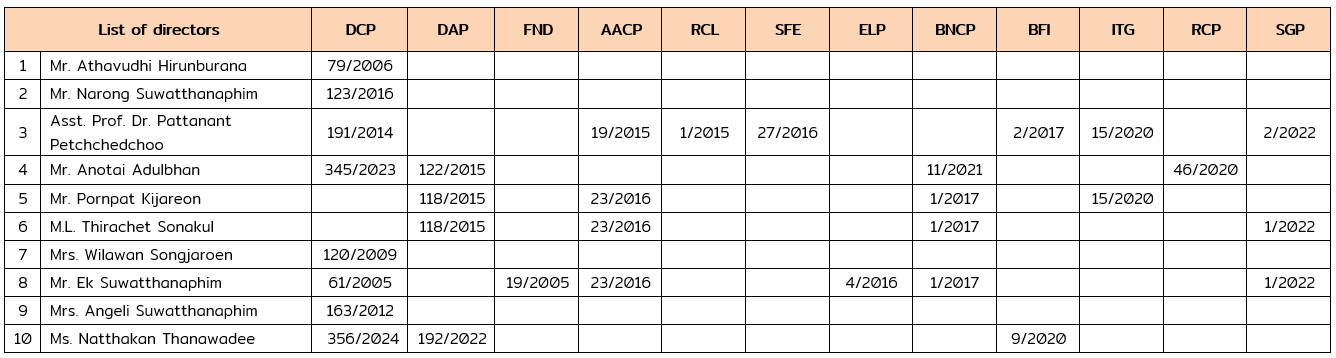
The Company encourages directors to attend training courses related to good corporate governance principles and sustainable development to enhance their skills, knowledge, and understanding of corporate governance and sustainable development.
Directors Orientation
For new directors appointed to the Board of Directors, the Company provides an orientation to ensure new directors are informed of the Company's business policies, as well as relevant information such as business structure, organizational structure, shareholders, operating results, internal systems information, and relevant laws and regulations. Useful information for performing duties as a company director is also provided. This information for directors includes:
|
|
|
|
3. Emergency Decree on Electronic Meetings 2020 |
|
4. Company registration certificate and objectives |
|
|
|
Development of Directors in the Past Year
Development of Directors and Senior Executives
10 Company Directors, 2 senior Executives, and managers 12 individuals received refresher training on the principles of good governance, business code of conducts and ESG on March 14, 2025.
Company Directors attended the training. E-learning basic sustainability knowledge program for Company Directors from the Stock Exchange of Thailand, comprising 3 courses: Course ESG 101 Fundamentals of Sustainability Knowledge, Course ESG 201 ESG Risk Management, and Course Certificate in ESG Management (C-ESG).
2 Senior Executives and managers 18 individuals participated in the ESG DNA sustainability knowledge program for personnel at all levels within the organization, in the form of E-Learning provided by the Stock Exchange of Thailand (4 mandatory courses), namely: Course ESG 101 ESG in Action, Course CE 201 Business Operations based on Circular Economy Principles, Course S02_1 Value Chain Analysis, and Course ESG 201 ESG Risk Management.
The highest-ranking Executive in Accounting and Finance received training in the course Corporate Finance Batch 2/2025 and Overview of Financial Reporting Standards Batch 3/2025.
Qualifications for Director Selection
| Qualification | Skill & Expertise |
|---|---|
| The Company has a diversity of skills, knowledge, capabilities, experience, professional skills, and appropriate specialized expertise, aligned with the Company’s business strategy and covering the professional fields necessary for policy formulation and effective corporate management. | 124 · Description: Petrochemicals & Chemicals · 147 · Description: Sustainability · 159 · Description: Engineering · 164 · Description: Strategic Management · 265 · Description: Governance/ Compliance |
Evaluation of Board & Subcommittee Performance
Criteria for Evaluating Board Performance
The Company's Board of Directors arranges for the performance evaluation of the Board and its sub-committees at least once a year. The evaluation of the Board is conducted both as a collective body and individually. Each evaluation form consists of two parts: a closed-ended question section and an open-ended question section, with each director required to complete both parts.
The Company's Board of Directors arranges for the performance evaluation of the Board and its sub-committees. The evaluation of the Board is conducted both as a collective body and individually, with the evaluation documents divided into 3 sets as follows:
Document Set 1: Self-Assessment Form for the Board of Directors (Collective).
Document Set 2: Self-Assessment Form for Directors (Individual).
Document Set 3: Self-Assessment Form for Sub-Committees (Collective).
The evaluation content covers the structure and qualifications of directors, roles, duties, and responsibilities, meeting attendance, performance of duties, self-development, and relationships with management. The objective is to review past performance, issues, and obstacles over the past year to enhance the effectiveness of the Board's work, foster awareness of their responsibilities, and develop good relationships with management.
Evaluation Process and Criteria.
Each evaluation form consists of two parts: a closed-ended question section and an open-ended question section, with each director required to complete both parts.
The scoring levels are as follows:
0 = Strongly disagree or no implementation of the matter.
1 = Disagree or minor implementation of the matter.
2 = Agree or reasonable implementation of the matter.
3 = Strongly agree or good implementation of the matter.
4 = Strongly agree or excellent implementation of the matter.
After receiving the evaluation results from each director, the scores will be averaged and a report will be prepared for the Board of Directors' meeting for acknowledgment of the evaluation results.
Evaluation Criteria.
Score greater than 85% = Excellent criterion
Score greater than 75% = Very Good criterion
Score greater than 65% = Good criterion
Score greater than 50% = Fair criterion
Score less than 50% = Needs Improvement criterion
Evaluation of Board Performance in the Past Year
Performance evaluation results of the Board of Directors and the Company's sub-committees in 2025
Summary of Directors' Self-Assessment Results | Score / Criteria Year 2024 | Score / Criteria Year 2025 | ||
Board Self-Assessment (by Committee) | 98% | Excellent | 97% | Excellent |
Board Self-Assessment (Individual) | 99% | Excellent | 98% | Excellent |
Overall Sub-Committee Performance Evaluation | 99% | Excellent | 99% | Excellent |
Board Self-Assessment (by Committee)
The overall evaluation results of the Board of Directors indicate excellent performance, with an average score of percentage 97. Details are as follows:
Evaluation topics | Average score percentage |
| 97 |
| 95 |
| 94 |
| 97 |
| 98 |
| 98 |
Average score | 97 |
Board Self-Assessment (Individual)
The overall individual Board member evaluation results indicate excellent performance, with an average score of 98%. Details are as follows:
Evaluation topics | Average score percentage |
| 99 |
| 97 |
| 96 |
| 98 |
5. Relationship with the Board and Management | 100 |
Average score | 98 |
Sub-Committee Self-Assessment (by Committee) comprising the Audit Committee, Nomination and Remuneration Committee, Risk Management Committee, Corporate Governance and Sustainable Development Committee, and Executive Committee. Each sub-committee member evaluates the performance of the sub-committee they serve on, on a committee-by-committee basis.
The summary of the sub-committee performance evaluation results (by committee) is as follows:
Sub-Committees | Average score percentage |
| 99 |
| 99 |
| 99 |
| 99 |
| 98 |
Average score | 99 |
Annual Performance Evaluation of the Chief Executive Officer
The Board of Directors has assigned the Nomination and Remuneration Committee to conduct an annual performance evaluation of the Chief Executive Officer for remuneration purposes. by establishing a framework of Key Performance Indicators ( Key Performance Indicators: KPIs) for the Chief Executive Officer, to align with sustainable growth strategies, create returns for stakeholders, and enhance long-term competitiveness. These are divided into 5 main categories as follows:
1. Financial Aspects (Financial KPIs)
The Company focuses on revenue growth and profitability, coupled with efficient investment and cost management. Key indicators include revenue growth ( Revenue Growth) and EBITDA margin, return on investment, and reduction of operating costs
2. Operational Aspects (Operational KPIs)
The Company prioritizes operational efficiency, supply chain continuity, and quality control. Key objectives include enhancing supply chain efficiency, maintaining quality standards, and complying with regulations.
3. Strategy and Innovation Aspects (Strategic & Innovation KPIs)
To support future growth, the Company has established key performance indicators focused on expanding business opportunities and investing in innovation, including new market expansion and investment in research and development ( R&D)
4. Sustainability Aspects (ESG KPIs)
The Company integrates key ESG into business operations concretely to create sustainability in all dimensions. Key objectives include reducing greenhouse gas emissions, increasing recycling rates and reducing waste, enhancing workplace safety, and complying with ESG requirements and relevant laws.
5. Leadership and Organizational Culture (Leadership & Culture KPIs)
The Company believes that personnel are the key to success, and thus has established indicators to strengthen a robust organizational culture, including employee engagement scores ( Employee Engagement Score) and internal leadership development
In 2025, the performance evaluation results of the Chief Executive Officer with an average score of 80.10%
Evaluation Results
| Evaluated Body | Group — Carried Out? | Group — Grade / Average Score | Group — Grade / Full Score | Individual (Self-Assessment) — Carried Out? | Individual (Self-Assessment) — Grade / Average Score | Individual (Self-Assessment) — Grade / Full Score | Cross (Assessing Other Directors) — Carried Out? |
|---|---|---|---|---|---|---|---|
| Board Of Director | Y | Excellent Criteria / 97 Percent | Excellent criteria / Over 85% | Y | Excellent Criteria / 98 Percent | Excellent / 100% | N |
| Audit Committee | Y | Excellent Criteria / 99 Percent | Excellent / 100% | N | N | ||
| Other Subcommittee | Y | Excellent Criteria / 99 Percent | Excellent / 100% | N | N | ||
| Other Subcommittee | Y | Excellent Criteria / 99 Percent | Excellent / 100% | N | N | ||
| Other Subcommittee | Y | Excellent Criteria / 99 Percent | Excellent / 100% | N | N | ||
| Executive Committee | Y | Excellent Criteria / 98 Percent | Excellent / 100% | N | N |
Subcommittees
Subcommittees
| Results of the Subcommittee's Duty Performance | Meetings — Introduction |
|---|---|
In 2025, the Risk Management Committee reported the results of its meetings to the Board of Directors on every occasion. The key outcomes of the Risk Management Committee's performance are summarized as follows:
| In 2025, the Risk Management Committee held a total of 4 meetings, all of which were conducted as E-Meetings. |
In 2025, the Nomination and Remuneration Committee consistently reported the meeting outcomes to the Board of Directors. The key performance highlights of the Nomination and Remuneration Committee are summarized as follows:
| In 2025, the Nomination and Remuneration Committee held a total of 2 meetings, both of which were physical meetings. |
In 2025, the Corporate Governance and Sustainable Development Committee reported the results of its meetings to the Board of Directors on every occasion. The key outcomes of the Corporate Governance and Sustainable Development Committee's performance are summarized as follows:
| In 2025, the Corporate Governance and Sustainable Development Committee held a total of 4 meetings, all of which were conducted as E-Meetings. |
Meeting Attendance & Remuneration
Meeting Attendance — Introduction
The Board of Directors has stipulated that for each Board meeting, at least half of the total number of directors must be present to constitute a quorum. Furthermore, for voting on each agenda item, at least two-thirds of the total number of directors must be present at the meeting to ensure transparency in decision-making.
The Board of Directors has set the meeting schedule for the entire year in advance. Meeting dates are scheduled during the second week of the month when quarterly financial statements are due, aligning with the deadline for submitting financial statements to the Stock Exchange. The meeting schedule has been communicated to all directors in advance.
The company secretary will send out meeting invitations, which include agendas for acknowledgment and agendas for consideration, along with meeting documents to the Board of Directors for their advance consideration, at least 5 business days prior. There was one meeting to define or review the organization's direction, strategies, and business plans, and one meeting of non-executive directors, and one meeting of independent directors. This is to support the principles of good corporate governance. The directors provided various suggestions beneficial to the Company and independently discussed the management's performance. The meeting assigned the management to consider and implement these suggestions further.
Meeting Attendance — Sub-section Introduction
In 2025, the Board of Directors held a total of 7 Board of Directors meetings, comprising 6 E-Meetings and 1 physical meeting.
Additionally, one meeting of non-executive directors and one meeting of independent directors were held.
Justification for Directors' Non-Attendance
Company directors who are unable to attend the Board of Directors meeting due to illness, urgent business, or travel abroad.
Meeting Attendance — Remark
Types of Remuneration of the Board of Directors
Policy and Structure for Director Remuneration for the Year 2025
The Annual General Meeting of Shareholders for 2025, held on April 28, 2025, resolved to approve the remuneration for the Board of Directors and sub-committees. The remuneration budget for the Board of Directors and sub-committees, comprising monthly remuneration, meeting allowances, bonuses, and shares from the Employment Joint Investment Program (EJIP), and bonuses, is set at a maximum of 8,000,000 Baht. Details are as follows:
Position | Year 2025 | |
Monthly Remuneration (Baht per month) | Meeting Allowance (Baht per meeting) | |
Chairman of the Board | 22,000 | 10,000 (Limited to not more than 6 times per year) |
Vice Chairman | 18,000 | 10,000 (Limited to not more than 6 times per year) |
Director | 10,000 | 15,000 (Limited to not more than 6 times per year) |
Chairman of the Audit Committee | - | 18,000 (1) |
Audit Committee Member | - | 15,000 (1) |
Chairman of the Risk Management Committee | - | 15,000 (1) |
Risk Management Committee Member | - | 13,000 (1) |
Chairman of the Nomination and Remuneration Committee | - | 15,000 (1) |
Nomination and Remuneration Committee Member | - | 10,000 (1) |
Chairman of the Corporate Governance and Sustainable Development Committee | - | 15,000 (1) |
Corporate Governance and Sustainable Development Committee Member | - | 10,000 (1) |
Remuneration of the Board of Directors
Remuneration or Benefits Payable to the Board
| Metric | Amount (Baht) |
|---|---|
| Remunerations or benefits pending payment to the board of directors over the past year (baht) | 0 |
Supervision of Subsidiaries & Associated Companies
Does the Company Have Subsidiaries or Associated Companies?
Yes
Is There a Mechanism for Overseeing Subsidiaries and Associated Companies?
Yes
Mechanism for Overseeing Management of Subsidiaries
The Company has established a policy for supervising the management of its subsidiaries and associated companies to enable the company to effectively supervise and manage their operations, in accordance with the prescribed measures and mechanisms, including ensuring that management adheres to the company's policies and complies with relevant laws, regulations, and criteria, in order to protect investment interests and oversee the subsidiaries and associated companies. The details are as follows:
1. The Company shall appoint representatives to serve as directors or executives in its subsidiaries and associated companies. The number of representatives serving as directors of subsidiaries and associated companies shall be in proportion to the company's shareholding in such subsidiaries and associated companies and/or in accordance with agreements made between the company and its subsidiaries and associated companies.
2. Directors or executives of subsidiaries and associated companies appointed by the company shall be responsible for supervising various prescribed matters.
3. If any subsidiary or associated company enters into any transaction that obligates the company to disclose information to the Stock Exchange of Thailand according to specified criteria, the subsidiary and associated company must immediately notify the company's management upon becoming aware of a plan to enter into such a transaction or the occurrence of such an event.
4. Directors and executives who are representatives of the Company in its subsidiaries and associated companies must ensure that no person with an interest in any matter or a conflict of interest with the subsidiaries and associated companies, whether direct or indirect, participates in the approval of such matter.
5. The Company shall supervise and monitor its subsidiaries and associated companies to ensure compliance with relevant laws, regulations, rules, and procedures, maintain good management practices, adhere to principles of good corporate governance, business ethics, and the company's anti-corruption policy, as well as other company policies or those consistent with the company's policies.
6. The Company shall regularly review performance reports from its subsidiaries and associated companies to formulate future operational plans and objectives.
Oversight Mechanisms
| Mechanism |
|---|
| Sending representatives to act as directors, executives or controlling persons in proportion to shareholdings |
| Defining the scope of powers, duties and responsibilities of directors and executives who represent the company in setting important policies |
| Disclosure of financial information and operating results |
| Transactions between the Company and related persons |
| Other important transactions |
| Acquisition or disposal of assets |
| Internal control system of the subsidiary operating the core business is appropriate and sufficient in the subsidiary operating the core business |
Board Duty Performance — Overview
Board Duty Performance — Overall Description
The Board of Directors has considered key issues encompassing legal compliance in corporate governance, risk management and internal audit, organizational strategies, and significant transactions, with details as follows:
Compliance with Relevant Laws and Regulations
The Board of Directors has considered and approved important matters in accordance with its roles and responsibilities, such as financial statements, dividend payments, shareholder meetings, related party transactions, appointment of directors and sub-committees, and the execution of significant company contracts, all to comply with laws and regulatory requirements.
Oversight of Management in Accordance with Good Corporate Governance Principles
The Board of Directors plays a crucial role in monitoring and considering various matters to ensure operations adhere to good corporate governance principles and international standards, such as ethics reports, securities trading reports of directors and executives, reports from sub-committees, revisions of sub-committee charters, and quarterly monitoring of corporate governance performance in other areas.
Key Strategies and Policies;
The Board of Directors emphasizes the formulation and implementation of organizational strategies, monitoring and ensuring the execution of defined strategies at quarterly board meetings. This includes reviewing key policies such as the vision, mission, organizational strategies, and Company KPIs to align with changing environments, updating the Anti-Corruption Policy, overseeing subsidiaries and associated companies, and considering various investments and business expansions.
In 2025, the Board of Directors, in collaboration with the Executive Committee and management, annually established the company's vision, mission, values, organizational strategies, operational plans, and budget, which contributes to sustainably enhancing the company's competitive capabilities. Furthermore, the Board of Directors oversees and assesses the adequacy of internal control systems, organizational risk management approaches, and reviews corporate governance and sustainability development policies to elevate corporate governance standards to be more robust and sustainable.
The Board of Directors continuously monitors the performance of the management, requiring reports on operating results, financial targets, and the progress of key projects to ensure operations align with established plans and objectives.
Audit Committee Duty Performance
Results of the Audit Committee's Duty Performance in the Past Year
Reviewed and provided opinions on the Company's annual and quarterly financial statements, to be presented to the Board of Directors' meeting for consideration and approval of the financial statements.
The Audit Committee reviewed significant information in the quarterly financial statements and the annual financial statements for 2025 of the Company and its subsidiaries to ensure that the financial reports of the Company and its subsidiaries were prepared correctly according to applicable accounting standards, with complete, sufficient, and reliable disclosure of information.
Furthermore, the Audit Committee met with the auditor without management present to discuss material issues in financial reporting, internal control systems, accounting and finance, as well as the independence of audit and review operations.
In 2568, the Company engaged KPMG Phoomchai Audit Ltd. to serve as the auditor for the Company's financial statements. The Audit Committee emphasized the auditor's role in maintaining independence in performing the audit of the entity's financial statements.
The Audit Committee considered and approved the engagement of the auditor without delegating authority to management to act independently. In the past year, no other services beyond those approved by the Audit Committee were found. The Audit Committee set the audit fee for the fiscal year 2025 (including quarterly financial statement reviews) at no more than 1,870,000 Baht, to be presented to the Board of Directors for approval and then to the Shareholders' Meeting for final approval.
Review of internal control systems and internal audit.
The Audit Committee reviewed the results of the internal control system assessment reported quarterly by the internal auditor. It was found to be adequate and appropriate for the company's current business operations, and consistent with the auditor's opinion, which reported that no material deficiencies affecting the Company's financial statements were found during the review. From the internal control assessment, it was found that the company can manage risks to reduce them to an acceptable level.
Other duties performed within the scope of the Audit Committee.
The Audit Committee performed its duties within its scope. In 2025, the Audit Committee reported the results of its meetings to the Board of Directors on every occasion. The key outcomes of the Audit Committee's performance are summarized as follows:
Reviewed related party transactions between the company and individuals who may have conflicts of interest.
Considered investment processes and summarized investment information reports of the Company, its subsidiaries, and associates.
Considered and acknowledged the operations in accordance with the anti-corruption policy and guidelines.
Considered the Audit Committee's report for the fiscal year 2025 for inclusion in the Company's annual information statement (Form 56-1 One Report) for the period ended December 31, 2025.
Reviewed the Audit Committee Charter.
The Audit Committee found that the Company's internal controls still had some areas requiring improvement. Therefore, discussions were held with the internal auditor and management to rectify and improve them. All identified issues have been resolved.
Executive Committee Duty Performance
Results of the Executive Committee's Duty Performance in the Past Year
The Executive Committee has performed its duties within the scope of authority, responsibilities, and accountability as defined in its charter. Key points are summarized as follows:
Determine the Company's strategic direction, including the annual business plan and budget, and establish related management structures, for submission to the Board of Directors for consideration.
Monitor the Company's performance, both financial and operational, and inform the Board of Directors.
Provide opinions on the Company's dividend policy to the Board of Directors.
Source and evaluate new business investment opportunities, then present them to the Board of Directors for consideration.
Consider and approve various company transactions, such as investment transactions, within the scope of authority delegated by the Board of Directors.
Provide opinions on various matters to be submitted to the Board of Directors for approval, except for items already considered by other sub-committees within their delegated authority.